
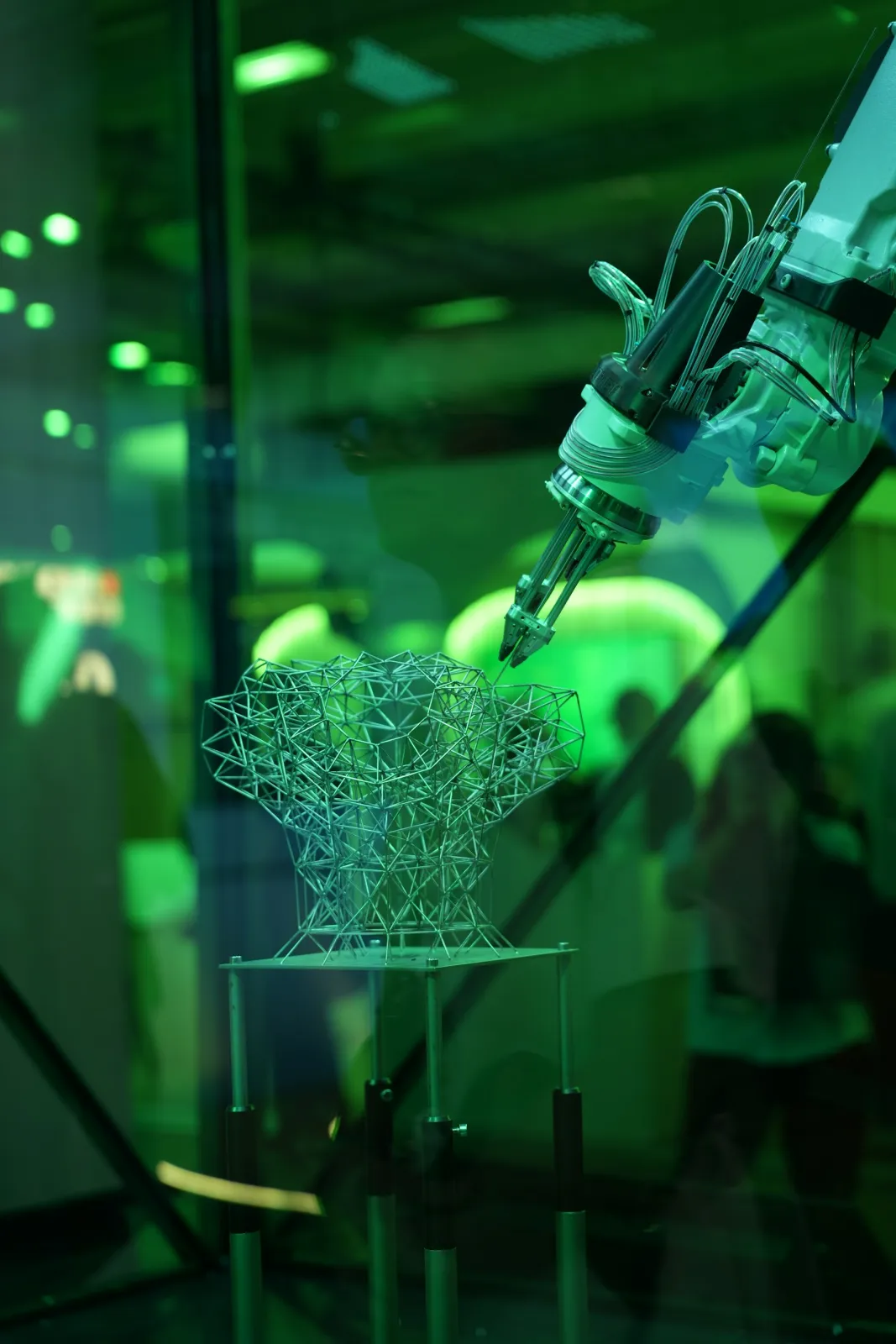
Why study at this faculty
Robotics and artificial intelligence have stopped being neighbouring fields. The systems that sense, decide and act in the physical world are built by the same engineers, and work is reorganising around them. This faculty prepares you for the point where the two meet.
Robotics and artificial intelligence have met
This is not a change that is about to happen. It has happened, and you are starting university in exactly the years when it settles.
01
Out of the computer
Models have started to move things
A model that recognises an image or predicts a value stayed on the screen for a long time. Today the same models drive robotic arms, driverless vehicles and unmanned aircraft. The difference is that a mistake no longer costs a poor result, but a broken part or a collision.
The field has a name, embodied artificial intelligence, and it calls for engineers who understand both the model and the mechanism it commands.
02
Industry
Companies have already started
At CES 2026, Boston Dynamics, Caterpillar, LG Electronics and NEURA Robotics showed robots driven by artificial intelligence. NVIDIA, which supplies the computing platform for many of them, calls the present moment "the ChatGPT moment of robotics".
NVIDIA also puts the humanoid robot market at 40 trillion dollars. That is a supplier's assessment of its own market, with no published methodology, so it appears here as a measure of industry expectations, not as a forecast.
The companies named above appear as a public industry reference point. None of them is a partner of the faculty. Partnerships will be published as they are signed.
03
What it means in practice
Someone has to build them
Public debate about automation is conducted from the point of view of the person replaced. But there is another side: behind every robot put into service there is an engineer who designed it, one who programmed it and one who maintains it. Those are the engineers this faculty trains.
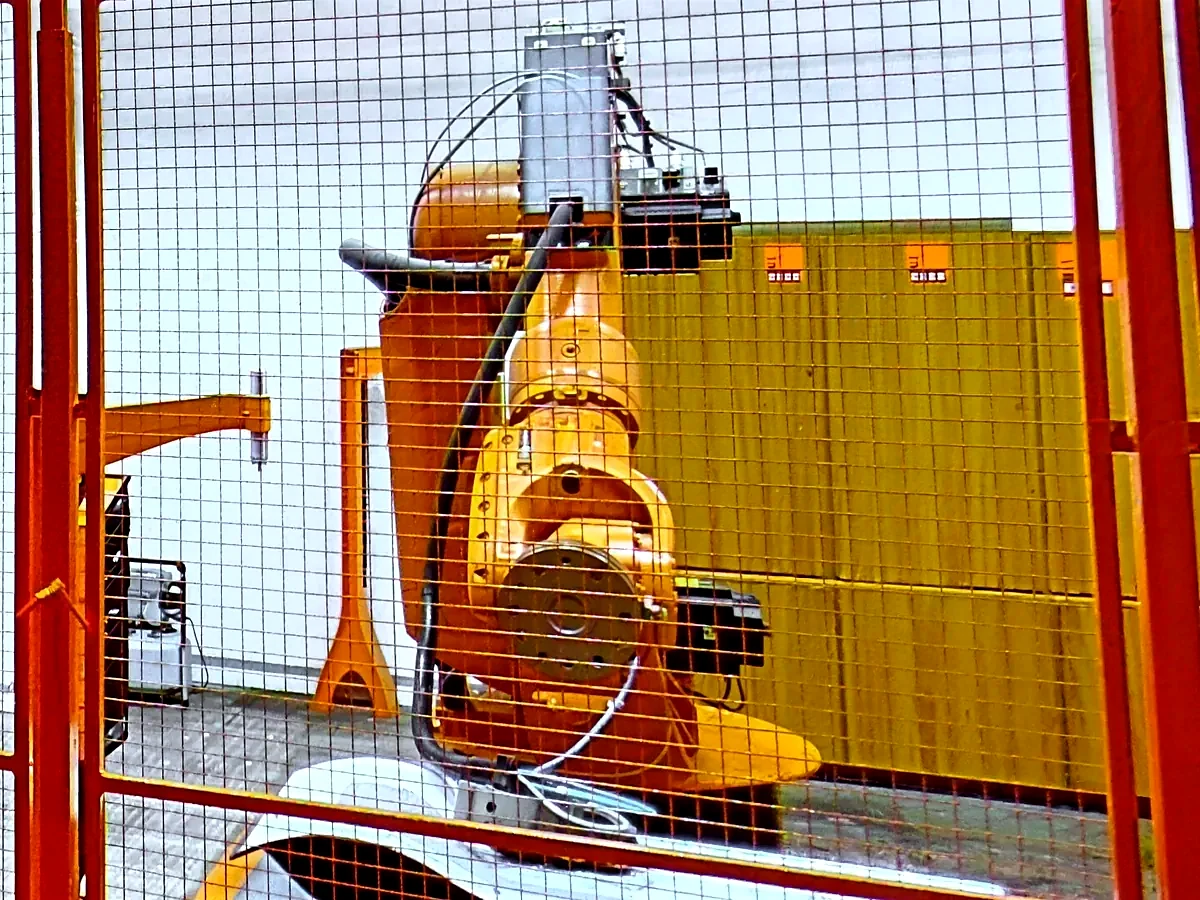
Work is becoming a partnership between people, agents and robots
The figures below are not the faculty's. They come from an international report on the labour market, quoted here because it describes exactly the environment you will work in.
58%
of working hours
could be automated in Europe with technology that exists today
70%
of today's skills
remain relevant even in work that cannot be automated
3000
billion dollars, in the United States by 2030
the estimated value of people, software agents and robots working together
The work of the future is a partnership between people, software agents and robots, all supported by artificial intelligence. Some roles shrink, others expand, and others appear.
Source: McKinsey Global Institute, „Agents, robots, and us: Skill partnerships in the age of AI”, November 2025. The full report.
What a candidate should take from this
Automation does not erase skills, it moves them. The ones that remain are exactly the ones you build by working on real systems: understanding a mechanism, programming it, and repairing it when it stops.
Six directions that meet in the same laboratory
Each has its own curriculum, but all of them use the same rigs and the same teaching staff. Choosing between them decides the emphasis, not the isolation.
- 01RoboticsFrom the third year you move on to ROS 2, machine learning and simultaneous localisation and mapping. You work on KUKA industrial robots, on teaching arms, on delta robots and on mobile platforms.
- 02MechatronicsYou learn mechanics, electronics and programming in parallel, not one after the other. The SMC and FESTO rigs and the additive manufacturing equipment are the ones used in class.
- 03Drone Engineering and Aeronautical InformaticsFlight dynamics is covered in three successive courses, with simulation, and the aerial platforms are built in the specialist laboratories. The curriculum is bilingual and teaching is in English.
- 04InformaticsThere are programming courses in every semester of the curriculum, and the integrative projects ask you to bring two courses together in a single assignment. In the third year you move on to networks, security and compiler techniques.
- 05Artificial IntelligenceThe dedicated programme is going through accreditation. Until it opens, artificial intelligence is studied within the existing programmes: machine learning and computer vision in robotics, algorithms and programming in computer science.
- 06Humanoid Robots and Autonomous SystemsThe dedicated programme is going through accreditation. Humanoid robots are the point where mechanics, control and artificial intelligence meet most closely, and their foundations are currently studied in the robotics and mechatronics programmes.
You do not learn about robots you work with them
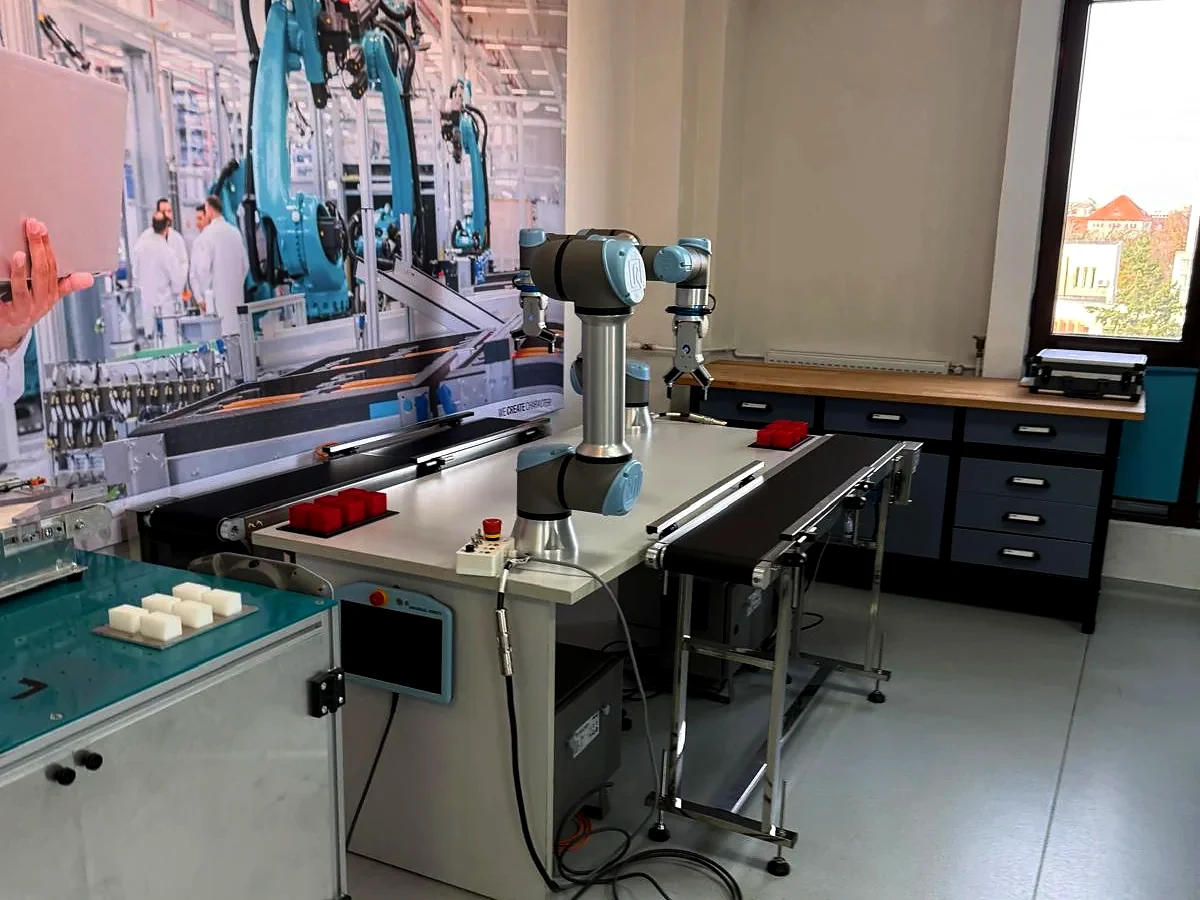
Most specialist courses have laboratory hours from the first year. The laboratories of the Faculty of Mechanical Engineering and of the Faculty of Automation and Computers hold modern equipment, in current use for teaching and research.
- 01KUKA industrial robots
- 02Teaching arms, delta and mobile robots
- 03SMC and FESTO rigs
- 04Bambu Lab and Ender 3D printers
- 05Universal Robots collaborative robots
- 06Meta Quest virtual reality headsets
- 07ROS 2, machine learning and SLAM
- 08Computer vision on real systems
Mechanics makes it move, electronics makes it sense, software drives it, and artificial intelligence makes it decide. Here all four layers sit in the same degree, not in four different faculties.
What you can do after graduating
These are not promises of employment. They are the occupations the courses in the curricula lead towards, as they appear in the job adverts of companies working in the field.
12
occupations in the faculty's fields, named precisely.
- 01Robotics engineer
- 02Mechatronics engineer
- 03Control systems engineer
- 04Computer vision specialist
- 05Autonomous systems engineer
- 06Embedded systems programmer
- 07Process engineer in smart manufacturing
- 08Applied machine learning specialist
- 09Robotic cell integrator
- 10Predictive maintenance engineer
- 11Drive systems designer
- 12Drone and aerial platform engineer
Where to go from here
Questions this page does not answer
For a particular situation with your file, or for something about the programmes that is still unclear, the faculty's address answers in writing.
Admission to the faculty's programmes
Applications are made on the admission platform of Politehnica University of Timisoara, together with those of the other faculties.